 Dreamland Villa is an isolated villa located in Ungasan, south of Bali . Not only is it isolated, it is also very private with only 39 villas to spare. This peaceful refuge screams privacy, and those who are seeking for a more entertaining holiday might want to skip this option as its remote location doesn’t make for a very exciting experience. It is though, an ideal location for honeymooners and couples looking to spend some silent time away from the chaos of the outside world.Opening its doors in July 2005, Dreamland Villa is one of the newer villas in the area and it shows as the interior and exterior are still pristine. The lobby area is relatively small compared to many but the welcome service is enough to make up for it. A refreshing tropical welcome drink and a cold towel is exactly what is needed after the long, winding and somewhat bumpy drive to its premises.The villas comprise of one, two and three bedroom accommodations, all of which are fully equipped with the conveniences needed. The interior of each room is traditionally fashioned without compromising luxury and comfort. All the comforts of modern technology such as a flat screen 29″ TV with in house movie and cable channels, home theatre system with DVD player, coffee and tea making facilities, shower jet massage, electronic bidet/toilet and many more to come with each villa. Its most fascinating feature would be the private pool, the landscaped gardens and the Balinese gazebo that comes with it. With features like that, there’s not much need to leave the comforts of the villa during your stay.But what is Bali without the beach and it is exactly that which handicaps Dreamland Villa for it is not a beach front property. Walking by the beach or sunbathing would require one to travel 5-10 minutes by shuttle to Bali ’s infamous Dreamland beach, known to many as surfers paradise. Might seem like a hassle, but the scenic drive will probably keep you occupied throughout the journey. Dreamland beach is relatively secluded and rather untouched and has managed to retain most of its natural beauty because of its remote location.SD’s verdict on Dreamland VillaIf you’re looking for an isolated, private and peaceful place that has the perfect setting for a romantic honeymoon, Dreamland Villa would certainly be on the top of the list. Being far flung from the happenings of the island wouldn’t be an issue once you’re engrossed in all the luxuries of the villas. The villas are relatively large and spacious enough to accommodate the Von Trapp family and it has all the basic necessities minus the grand piano.
Saturday, January 22, 2011
Dreamland Villas – The Dream Destination Of Bali Villa In Kuta
Dreamland Villa is an isolated villa located in Ungasan, south of Bali . Not only is it isolated, it is also very private with only 39 villas to spare. This peaceful refuge screams privacy, and those who are seeking for a more entertaining holiday might want to skip this option as its remote location doesn’t make for a very exciting experience. It is though, an ideal location for honeymooners and couples looking to spend some silent time away from the chaos of the outside world.Opening its doors in July 2005, Dreamland Villa is one of the newer villas in the area and it shows as the interior and exterior are still pristine. The lobby area is relatively small compared to many but the welcome service is enough to make up for it. A refreshing tropical welcome drink and a cold towel is exactly what is needed after the long, winding and somewhat bumpy drive to its premises.The villas comprise of one, two and three bedroom accommodations, all of which are fully equipped with the conveniences needed. The interior of each room is traditionally fashioned without compromising luxury and comfort. All the comforts of modern technology such as a flat screen 29″ TV with in house movie and cable channels, home theatre system with DVD player, coffee and tea making facilities, shower jet massage, electronic bidet/toilet and many more to come with each villa. Its most fascinating feature would be the private pool, the landscaped gardens and the Balinese gazebo that comes with it. With features like that, there’s not much need to leave the comforts of the villa during your stay.But what is Bali without the beach and it is exactly that which handicaps Dreamland Villa for it is not a beach front property. Walking by the beach or sunbathing would require one to travel 5-10 minutes by shuttle to Bali ’s infamous Dreamland beach, known to many as surfers paradise. Might seem like a hassle, but the scenic drive will probably keep you occupied throughout the journey. Dreamland beach is relatively secluded and rather untouched and has managed to retain most of its natural beauty because of its remote location.SD’s verdict on Dreamland VillaIf you’re looking for an isolated, private and peaceful place that has the perfect setting for a romantic honeymoon, Dreamland Villa would certainly be on the top of the list. Being far flung from the happenings of the island wouldn’t be an issue once you’re engrossed in all the luxuries of the villas. The villas are relatively large and spacious enough to accommodate the Von Trapp family and it has all the basic necessities minus the grand piano.
Bali

DESCRIBING A FAMOUS ISLAND “BALI”
Have you heard about one of the most beautiful islands in the world? That’s right, that is “Bali”. It is located in Indonesia. I have visited Bali twice and I felt comfort there. Maybe everyone call Bali “Pulau Dewata” because almost all the people there is Hindu, but I call it “Paradise Island”. There are two things that make Bali interesting; the beautiful scenery and the culture.
If you have visited Bali, you would see some Hindu’s temples (pura) and a lot of beautiful beaches. For example, “Kuta beach”, where you will see a lot of tourists there and you can enjoy the view of the beach. Surfing, playing volley, building sand castle, sunbathing, and taking photos are the common activities that you can do there. Besides the beach, you can also visit the temple (pura) and a lot of markets for buying souvenirs.
Bali is not just an island to look at. You can communicate with the friendly people around there. There are some traditional restaurants you can visit for trying the delicious traditional food. If you are lucky enough to be in Bali Island, you can also see the interesting traditional culture related to Hinduism around there, such as the traditional dances, the ceremony, holy events, and many more.
All in all, Bali is a delightful island to visit. It embodies the traditional culture with all of amazing places around there.


Kuta - Bali

If you want to enjoy feel of Kuta Beach, Beach Along the right place. Throughout a long coastline, white sand that is still awake, and the waves are. You can just choose to sunbathe on the sand enjoying the bright sun, surfing, or just see the beauty of the beach.


Rent Car
We also rent cars and drivers for your trip during a vacation in Bali so you do not need hard to find cars.we ready to serve you in Bali.

Motorcycle
for those of you who love riding motorcycles .we also provided so you can be free only where appropriate destination.
Email : weddingcamera@yahoo.com
Contact :+6281236912900.
Privacy Policy
Privacy Policy for http://very-beautiful-scenery-in-bali.blogspot.com/
If you require any more information or have any questions about our privacy policy, please feel free to contact us by email at andrean1090v@gmail.com.
At http://very-beautiful-scenery-in-bali.blogspot.com/, the privacy of our visitors is of extreme importance to us. This privacy policy document outlines the types of personal information is received and collected by http://very-beautiful-scenery-in-bali.blogspot.com/ and how it is used.
Log Files
Like many other Web sites, http://very-beautiful-scenery-in-bali.blogspot.com/ makes use of log files. The information inside the log files includes internet protocol ( IP ) addresses, type of browser, Internet Service Provider ( ISP ), date/time stamp, referring/exit pages, and number of clicks to analyze trends, administer the site, track user’s movement around the site, and gather demographic information. IP addresses, and other such information are not linked to any information that is personally identifiable.
Cookies and Web Beacons
http://very-beautiful-scenery-in-bali.blogspot.com/ does use cookies to store information about visitors preferences, record user-specific information on which pages the user access or visit, customize Web page content based on visitors browser type or other information that the visitor sends via their browser.
DoubleClick DART Cookie
.:: Google, as a third party vendor, uses cookies to serve ads on http://very-beautiful-scenery-in-bali.blogspot.com/.
.:: Google's use of the DART cookie enables it to serve ads to users based on their visit to http://very-beautiful-scenery-in-bali.blogspot.com/ and other sites on the Internet.
.:: Users may opt out of the use of the DART cookie by visiting the Google ad and content network privacy policy at the following URL - http://www.google.com/privacy_ads.html
Some of our advertising partners may use cookies and web beacons on our site. Our advertising partners include ....
Google Adsense
Commission Junction
Widget Bucks
Adbrite
Clickbank
Azoogle
Chitika
Linkshare
Amazon
Kontera
These third-party ad servers or ad networks use technology to the advertisements and links that appear on http://very-beautiful-scenery-in-bali.blogspot.com/ send directly to your browsers. They automatically receive your IP address when this occurs. Other technologies ( such as cookies, JavaScript, or Web Beacons ) may also be used by the third-party ad networks to measure the effectiveness of their advertisements and / or to personalize the advertising content that you see.
http://very-beautiful-scenery-in-bali.blogspot.com/ has no access to or control over these cookies that are used by third-party advertisers.
You should consult the respective privacy policies of these third-party ad servers for more detailed information on their practices as well as for instructions about how to opt-out of certain practices. http://very-beautiful-scenery-in-bali.blogspot.com/'s privacy policy does not apply to, and we cannot control the activities of, such other advertisers or web sites.
If you wish to disable cookies, you may do so through your individual browser options. More detailed information about cookie management with specific web browsers can be found at the browsers' respective websites.
If you require any more information or have any questions about our privacy policy, please feel free to contact us by email at andrean1090v@gmail.com.
At http://very-beautiful-scenery-in-bali.blogspot.com/, the privacy of our visitors is of extreme importance to us. This privacy policy document outlines the types of personal information is received and collected by http://very-beautiful-scenery-in-bali.blogspot.com/ and how it is used.
Log Files
Like many other Web sites, http://very-beautiful-scenery-in-bali.blogspot.com/ makes use of log files. The information inside the log files includes internet protocol ( IP ) addresses, type of browser, Internet Service Provider ( ISP ), date/time stamp, referring/exit pages, and number of clicks to analyze trends, administer the site, track user’s movement around the site, and gather demographic information. IP addresses, and other such information are not linked to any information that is personally identifiable.
Cookies and Web Beacons
http://very-beautiful-scenery-in-bali.blogspot.com/ does use cookies to store information about visitors preferences, record user-specific information on which pages the user access or visit, customize Web page content based on visitors browser type or other information that the visitor sends via their browser.
DoubleClick DART Cookie
.:: Google, as a third party vendor, uses cookies to serve ads on http://very-beautiful-scenery-in-bali.blogspot.com/.
.:: Google's use of the DART cookie enables it to serve ads to users based on their visit to http://very-beautiful-scenery-in-bali.blogspot.com/ and other sites on the Internet.
.:: Users may opt out of the use of the DART cookie by visiting the Google ad and content network privacy policy at the following URL - http://www.google.com/privacy_ads.html
Some of our advertising partners may use cookies and web beacons on our site. Our advertising partners include ....
Google Adsense
Commission Junction
Widget Bucks
Adbrite
Clickbank
Azoogle
Chitika
Linkshare
Amazon
Kontera
These third-party ad servers or ad networks use technology to the advertisements and links that appear on http://very-beautiful-scenery-in-bali.blogspot.com/ send directly to your browsers. They automatically receive your IP address when this occurs. Other technologies ( such as cookies, JavaScript, or Web Beacons ) may also be used by the third-party ad networks to measure the effectiveness of their advertisements and / or to personalize the advertising content that you see.
http://very-beautiful-scenery-in-bali.blogspot.com/ has no access to or control over these cookies that are used by third-party advertisers.
You should consult the respective privacy policies of these third-party ad servers for more detailed information on their practices as well as for instructions about how to opt-out of certain practices. http://very-beautiful-scenery-in-bali.blogspot.com/'s privacy policy does not apply to, and we cannot control the activities of, such other advertisers or web sites.
If you wish to disable cookies, you may do so through your individual browser options. More detailed information about cookie management with specific web browsers can be found at the browsers' respective websites.
Sunday, December 12, 2010
INDEX
THAILAND
 Spoiling visitor on Seraya Island - West Flores
 Salang beach on Tioman
LADY TEZZA'S TRAVELLING JAPAN
 Fashions for sale in Takeshita dori - Tokyo
The basics - Osaka - Kyoto - Hiroshima&Himeji - Takayama - Tokyo - Kyushu - Daytrip to Mt Fuji National Park - Accessing your money - Other helpul stuff

Post-sunset shot at Ko Adang National Park headquarters beach.
INTRODUCTION - WHICH ISLAND OR BEACH?
CHANG (big Chang eastern Gulf)
Little Ko CHANG, Andaman side
PHI PHI
PHI PHI NEWSPAPER ARTICLE BY TEZZA
RAILAY, TON SAI AND KRABI TOWN
General Thailand Information
SOME TIPS ON NOT DROWNING
WET WEATHER INFORMATION
SNORKELLING IN THAILAND
INDONESIA
 Spoiling visitor on Seraya Island - West Flores
BALI'S BEST BEACHES - incl THE BUKIT PENINSULA
EAST BALI - PADANGBAI & CANDIDASA
LOMBOK - THE GILI ISLANDS
LOMBOK - THE KUTA LOMBOK AREA
PERAMA SLOW BOAT - FLORES/KOMODO/LOMBOK
SERAYA & KANAWA ISLANDS + LABUANBJO - FLORES
MALAYSIA
 Salang beach on Tioman
GEORGEOUS TIOMAN ISLAND
LANGKAWI
AUSTRALIA  Bound for Hook Island on Oetella
CRUISING TROPICAL ISLANDS ON A BUDGET
BUDGET RESORTING ON THE WHITSUNDAY ISLANDS
BYRON BAY - BEACH PARADISE
TURKEY Paragliding Mount Babadag to Oludeniz Beach
BUDGET CRUISING AND PARAGLIDING THE TURQOUISE COAST
READERS' TRIP REPORTS Trip reporter Cocodrilo at Similan's viewpoint
THE FORUM Yon Cassia has a lean and hungry look (image Deco Dermots)
Questions, comments, shoot the bull.
GENERAL  Kwak joins the Worry Collective - image BEDARD
JUST FOR LARFS - PART 1
JUST FOR LARFS - PART 2: STONES FROM THE JOKER IN THE GLASS HOUSE (1 thru 11)
JUST FOR LARFS - PART 3: THE WORRY COLLECTIVE
LADY TEZZA'S TRAVELLING JAPAN
 Fashions for sale in Takeshita dori - Tokyo
The basics - Osaka - Kyoto - Hiroshima&Himeji - Takayama - Tokyo - Kyushu - Daytrip to Mt Fuji National Park - Accessing your money - Other helpul stuff
Tuesday, December 7, 2010


Mendut Temple
Mendut Temple

Mendut was once linked to Borobudur by stone-paved walk, which passed by Pawon. All three sanctuaries are Buddhist, belong to the same period, and there was apparently some ritual link between them. It is believed that pilgrims assembled at Mendut and then processed down the 3 kilometers path to Borobudur, with stay for meditation at Pawon. The beautiful reliefs on the walls of the temple are the largest that have yet been found in Indonesia. They cover each of the main surfaces of the back and two sidewalls with large single panels. The central figures of these reliefs are male or female Bodhisattvas, being who postpone achieving Buddhahood in order to help men. On the short returns decorating each wall there are single figures of Bodhisattvas. The much smaller, but no less delicate reliefs on the balustrade and on the triangles formed by the walls to the stairs are filled with fables from the Jataka stories. With such beauty on the outside, it should not be surprising to find that the single chamber of the temple is even more impressive and just as in fine workmanship. There is a 3 meters high statue of the Lord Buddha as Sakyamuni, Light of the World, delivering his first sermon in the deer park, as shown by small figures under the footstool. He is flanked on his right by a somewhat smaller statue of Bodhisattva Avalokitesvara, and on his left, by similar statue of Bodhisattva Vajrapani. Each of these statues has been hewn from a single block of stone, which has saved them from the destruction that has overtaken so many other statues smaller in size, or made bronze and other metals that have been melted down and used for other purposes Whatever other decorations there once were in this chamber, they could hardly have improved the atmosphere of serenity and devotion still to be found there today. Lit with oil lamps and adorned with masses of flowers, glory was once present in Mendut.

LocationAdministratively, Mendut temple is located at Mendut village, Mungkid Magelang Regency, Central Java. This location is 2 kilometers southeast of Magelang. It is easy accessible by any vehicle either two or four wheeled-ones. This temple is nearby the most popular Borobudur temple, one of Seven Wonders of the World. As usual, for tourists, especially foreign ones, a visit to Mendut temple is scheduled in the same package with that to Borobudur and Pawon temples. Exclusively for Mahayana Buddhist, these three temples are closely interrelated. To be noted, when it is full moon, at the date of 15 according to Javanese calendar (usually on May), in Tri Suci Waicak day, this location is usually used as the place of ritual process by Buddha people. And this ritual process becomes a great attraction for either local or foreign tourists.

Discovery and RestorationIn 1986, Mendut temple structures, save its roof, were found to be hidden in marshy area. Then it was again discovered, cleaned and dug in 1897, its base and body were restored but not yet satisfactory. The next restoration done by Th. Van Erp in 1908, in time of Borobudur restoration. In this year part of its roof was rearranged, and in 1925, some small stupas could be placed again on the tops.
Foundation of the TempleHistorians estimated that Mendut temple was founded in the ninth century by the Syailendra dynasty. This estimation was on the ground of Karang Tengah script written in 824 AD. Mentioned on the script that Indra, the king, built a sacred building named Venuvara, which is called Mendut Temple.
Structure of the Mendut Temple
Temple ReliefsThe temple stands on high enough basement, making it looks more attractive and strong. The ladder and entrance face to northwest, meaning that this temple faces to that direction. It is absolutely the characteristic of Mendut temple for the most temples in Central Java generally face to the east. Above the basement there is a tunnel surrounding the body of the temple. The top has three floors and decorated with 48 small stupas. Looking at the construction, the top of Mendut temple seems to be covered with a huge roof. The height of the temple is approximately 2.4 meters. The Mendut temple has outstanding attraction rarely found in other temples in Java or even in Indonesia. The existence of relatively three large enough statues inside the temple has its special high beauty either physically or artistically. As far as Buddhist is concerned, those three statues reflect sacred light. Each of the three was made of a slab of stone, indicating how extraordinary artistic craft of our ancestor. Their details are as follow:

Dyani Buddha Cakyamuni
This statue looks to west in sitting position, its two legs nudged down, touching teratai base and the position of Dharmacakramudra hand symbolizes being busy turning around the life cycles.
Arcabodhisattva Avalokitesvara/Lokesvara
This statue is located next to Buddha Cakyamuni, facing to south. It is in sitting position, its left leg bent inward and other one sticks straightly downward. The position of Varamudra hand symbolizes being busy teaching the tenets, and is shown wearing notability dresses, namely crown, jewellery on its ear, hand, neck, and shoulder.
Bodhisattvarajrapani
It is located on the right hand of Cakyamuni statue, looking to south. Likewise cakyamuni, this statue wears nobility dress. He is also in sitting position, his right hand bent down and his left one touches his tight. As for his left leg, it sticks straight downward. The decoration of relief scattered on the surfaces of outer wall of its basement and temple body makes the Mendut temple much more attractive, its motives and the themes of its decoration are derived from Buddha myths and symbols, especially Jataka myth. There are synopsis actions of Jatayu curved on panels of outer side of the ladder and the bottom of the temple. One of the panels on right hand side of the outside ladder reflects stories about turtles that were in danger, being secured by two birds by biting both ends of the wood and then brought them to a garden. There is also Jataka myth that telling about a monkey cheats a crocodile. On this relief is shown a monkey sitting on the back of a crocodile.

Other attractive reliefs on the body of the temple are:
Kuvera/Yaksa/Panthika/Arawika Relief
This relief is found on right hand side of the entrance leading to the inside part of the temple, reflecting a man figure surrounded by children. Under his chair there are urns filled with money. The money filled-urn is one of attributes of Kuvera goodness. In Buddha anthology, he is formerly a men-eater monster who repented and changed to be children protector after seeing Buddha.
Hariti Relief
On the right side of the entrance of temple room, there is Hariti relief. Hariti is shown in sitting position with a child on her lap. Likewise Kuvera, she was formerly a man-eater monster who repented and changed to be children protector as soon as she met Buddha. Furthermore, she is known as fertility goodness.
Bodhisattva Avalokitesvara and Dewi Tara Relief
This one is on the body wall on south side of Avalokitesvara relief, curved on a part of central panel, sitting on Padmasana and on the either sides of him sat his princess Dewi Tara. Beneath Padmasana is a pond filled with teratai. In Buddha mythology, this relief describes story telling about the birth of Dewi Tara. A part of those reliefs, there are others describing Bodhisattva, that is on east side of the wall, Dewi Tara on north side and some other relief in the forms of flora.

Mendut was once linked to Borobudur by stone-paved walk, which passed by Pawon. All three sanctuaries are Buddhist, belong to the same period, and there was apparently some ritual link between them. It is believed that pilgrims assembled at Mendut and then processed down the 3 kilometers path to Borobudur, with stay for meditation at Pawon. The beautiful reliefs on the walls of the temple are the largest that have yet been found in Indonesia. They cover each of the main surfaces of the back and two sidewalls with large single panels. The central figures of these reliefs are male or female Bodhisattvas, being who postpone achieving Buddhahood in order to help men. On the short returns decorating each wall there are single figures of Bodhisattvas. The much smaller, but no less delicate reliefs on the balustrade and on the triangles formed by the walls to the stairs are filled with fables from the Jataka stories. With such beauty on the outside, it should not be surprising to find that the single chamber of the temple is even more impressive and just as in fine workmanship. There is a 3 meters high statue of the Lord Buddha as Sakyamuni, Light of the World, delivering his first sermon in the deer park, as shown by small figures under the footstool. He is flanked on his right by a somewhat smaller statue of Bodhisattva Avalokitesvara, and on his left, by similar statue of Bodhisattva Vajrapani. Each of these statues has been hewn from a single block of stone, which has saved them from the destruction that has overtaken so many other statues smaller in size, or made bronze and other metals that have been melted down and used for other purposes Whatever other decorations there once were in this chamber, they could hardly have improved the atmosphere of serenity and devotion still to be found there today. Lit with oil lamps and adorned with masses of flowers, glory was once present in Mendut.

LocationAdministratively, Mendut temple is located at Mendut village, Mungkid Magelang Regency, Central Java. This location is 2 kilometers southeast of Magelang. It is easy accessible by any vehicle either two or four wheeled-ones. This temple is nearby the most popular Borobudur temple, one of Seven Wonders of the World. As usual, for tourists, especially foreign ones, a visit to Mendut temple is scheduled in the same package with that to Borobudur and Pawon temples. Exclusively for Mahayana Buddhist, these three temples are closely interrelated. To be noted, when it is full moon, at the date of 15 according to Javanese calendar (usually on May), in Tri Suci Waicak day, this location is usually used as the place of ritual process by Buddha people. And this ritual process becomes a great attraction for either local or foreign tourists.

Discovery and RestorationIn 1986, Mendut temple structures, save its roof, were found to be hidden in marshy area. Then it was again discovered, cleaned and dug in 1897, its base and body were restored but not yet satisfactory. The next restoration done by Th. Van Erp in 1908, in time of Borobudur restoration. In this year part of its roof was rearranged, and in 1925, some small stupas could be placed again on the tops.
Foundation of the TempleHistorians estimated that Mendut temple was founded in the ninth century by the Syailendra dynasty. This estimation was on the ground of Karang Tengah script written in 824 AD. Mentioned on the script that Indra, the king, built a sacred building named Venuvara, which is called Mendut Temple.
Structure of the Mendut Temple
Temple ReliefsThe temple stands on high enough basement, making it looks more attractive and strong. The ladder and entrance face to northwest, meaning that this temple faces to that direction. It is absolutely the characteristic of Mendut temple for the most temples in Central Java generally face to the east. Above the basement there is a tunnel surrounding the body of the temple. The top has three floors and decorated with 48 small stupas. Looking at the construction, the top of Mendut temple seems to be covered with a huge roof. The height of the temple is approximately 2.4 meters. The Mendut temple has outstanding attraction rarely found in other temples in Java or even in Indonesia. The existence of relatively three large enough statues inside the temple has its special high beauty either physically or artistically. As far as Buddhist is concerned, those three statues reflect sacred light. Each of the three was made of a slab of stone, indicating how extraordinary artistic craft of our ancestor. Their details are as follow:

Dyani Buddha Cakyamuni
This statue looks to west in sitting position, its two legs nudged down, touching teratai base and the position of Dharmacakramudra hand symbolizes being busy turning around the life cycles.
Arcabodhisattva Avalokitesvara/Lokesvara
This statue is located next to Buddha Cakyamuni, facing to south. It is in sitting position, its left leg bent inward and other one sticks straightly downward. The position of Varamudra hand symbolizes being busy teaching the tenets, and is shown wearing notability dresses, namely crown, jewellery on its ear, hand, neck, and shoulder.
Bodhisattvarajrapani
It is located on the right hand of Cakyamuni statue, looking to south. Likewise cakyamuni, this statue wears nobility dress. He is also in sitting position, his right hand bent down and his left one touches his tight. As for his left leg, it sticks straight downward. The decoration of relief scattered on the surfaces of outer wall of its basement and temple body makes the Mendut temple much more attractive, its motives and the themes of its decoration are derived from Buddha myths and symbols, especially Jataka myth. There are synopsis actions of Jatayu curved on panels of outer side of the ladder and the bottom of the temple. One of the panels on right hand side of the outside ladder reflects stories about turtles that were in danger, being secured by two birds by biting both ends of the wood and then brought them to a garden. There is also Jataka myth that telling about a monkey cheats a crocodile. On this relief is shown a monkey sitting on the back of a crocodile.

Other attractive reliefs on the body of the temple are:
Kuvera/Yaksa/Panthika/Arawika Relief
This relief is found on right hand side of the entrance leading to the inside part of the temple, reflecting a man figure surrounded by children. Under his chair there are urns filled with money. The money filled-urn is one of attributes of Kuvera goodness. In Buddha anthology, he is formerly a men-eater monster who repented and changed to be children protector after seeing Buddha.
Hariti Relief
On the right side of the entrance of temple room, there is Hariti relief. Hariti is shown in sitting position with a child on her lap. Likewise Kuvera, she was formerly a man-eater monster who repented and changed to be children protector as soon as she met Buddha. Furthermore, she is known as fertility goodness.
Bodhisattva Avalokitesvara and Dewi Tara Relief
This one is on the body wall on south side of Avalokitesvara relief, curved on a part of central panel, sitting on Padmasana and on the either sides of him sat his princess Dewi Tara. Beneath Padmasana is a pond filled with teratai. In Buddha mythology, this relief describes story telling about the birth of Dewi Tara. A part of those reliefs, there are others describing Bodhisattva, that is on east side of the wall, Dewi Tara on north side and some other relief in the forms of flora.
Gedongsongo Temple
Gedongsongo Temple

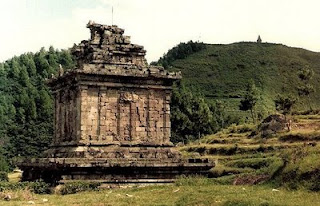
Gedong Songo temple, is a Hindu temple located in the highlands at the foot of the mountain Ungaran Semarang. For hundreds of years the temple was standing on a hilly plateau region of the hill. This area is included in the district Bandungan, one area that is termed as the top city of Semarang.

This temple consists of nine main temple building. To reach this location is not far, just one hour journey from Semarang city without traffic jams and only forty-five minutes from the town of Salatiga. Managed by local government, this area is quite nice and well maintained.

Many facilities that support and draw there. You can try to ride a horse, just spend less than 25 thousand rupiah you are entitled to get around in around the temple which the way up and down with the horse. You do not have to worry if you come in Gedong Songo Temple, not far from the temple Bandungan precisely at the hotel you can rest at the hotel who were there.

Overnight rates are relatively varied, from fifty thousand rupiah at the motel until the five-star hotels
Thus, what is far away if your holiday in our country a lot of interest


Gedong Songo temple, is a Hindu temple located in the highlands at the foot of the mountain Ungaran Semarang. For hundreds of years the temple was standing on a hilly plateau region of the hill. This area is included in the district Bandungan, one area that is termed as the top city of Semarang.

This temple consists of nine main temple building. To reach this location is not far, just one hour journey from Semarang city without traffic jams and only forty-five minutes from the town of Salatiga. Managed by local government, this area is quite nice and well maintained.

Many facilities that support and draw there. You can try to ride a horse, just spend less than 25 thousand rupiah you are entitled to get around in around the temple which the way up and down with the horse. You do not have to worry if you come in Gedong Songo Temple, not far from the temple Bandungan precisely at the hotel you can rest at the hotel who were there.


Overnight rates are relatively varied, from fifty thousand rupiah at the motel until the five-star hotels
Thus, what is far away if your holiday in our country a lot of interest


Monday, December 6, 2010
Ulun Danu Temple, Bali-Indonesia
Ulun Danu Temple

While I know funny kind of signs aka “Don’t pee in the elevator – Fine 2.000$!” from Singapore; I wasn’t aware that other countries are worried about their citizen’s hygienic toilet behaviors as well.

It came a bit as a surprise to see a similar sign at Bali’s beautiful Water Temple – Pura Ulun Danu – near the small town of Bedugul at Lake Bratan (“Holy Mountain Lake”). Bedugul is most famous for it’s Strawberry Fields, which provide a fresh, red harvest almost all-year-round due to the higher and cooler climate…

The Temple close to the Lake’s Water is dedicated to Dewi Danu, the Goddess for all Lakes and Rivers.
Pura Ulun Danu has a 11-storey ‘Meru’ (or Pagoda) and besides Dewi Danu – other Gods like Shiva and his wife Parvati are worshiped here as well.

While I know funny kind of signs aka “Don’t pee in the elevator – Fine 2.000$!” from Singapore; I wasn’t aware that other countries are worried about their citizen’s hygienic toilet behaviors as well.

It came a bit as a surprise to see a similar sign at Bali’s beautiful Water Temple – Pura Ulun Danu – near the small town of Bedugul at Lake Bratan (“Holy Mountain Lake”). Bedugul is most famous for it’s Strawberry Fields, which provide a fresh, red harvest almost all-year-round due to the higher and cooler climate…

The Temple close to the Lake’s Water is dedicated to Dewi Danu, the Goddess for all Lakes and Rivers.
Pura Ulun Danu has a 11-storey ‘Meru’ (or Pagoda) and besides Dewi Danu – other Gods like Shiva and his wife Parvati are worshiped here as well.
Plaosan Temple
Plaosan Temple
 The temple at Plaosan, in Klaten area of Central Java, not far from Sewu Temple, was unique, so far as our knowledge goes today. In the first place, Plaosan was built by a Syailendra princess, and so a Buddhist, and her husband, Rakai Pikatan, a Hindu ruler of Mataram. Thus Plaosan is one of the several examples that have been found of religious tolerance. The structure of the compounds was also unique. There were two of them, lying north and south of each other, the northern one with two main temples, each is its own walled court with a portal between them, the southern compound with only one large temple. Each group was surrounded by rows of small shrines and stupas, linking them together. There was still another court in the northern compound. This Buddhist sanctuary has suffered considerable damage since it was first built in the 9th century. Some entrance gate ways have been found and they marked by stone guardians. Other temple that visitor can visit near the Prambanan group temple are: temple of Sawijen, Kalasan.

Dieng Temples
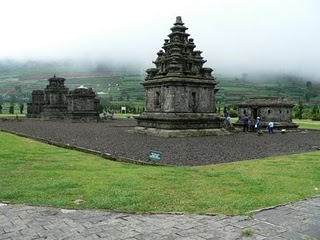
Indonesia have many temple archeological remains. One of them is Dieng Temples Group, consists of four group of temple. Located in Dieng Plateu, Central Java.
ARJUNA TEMPLE
This Temple Group is consisted of five temples which are built in two parallel lines.The eastern line consist of four,mostly facing westward respectively the temples of Arjuna,Srikandi,Puntadewa and Sembadra.While, the western line temple which stands face to face with Arjuna Temple.At these temple are depicted about the accon panying Dieties of Siwa.While at the Srikandi is depicted on the recess of the temple about all the main deities if Hinduism,they are Brahmana,Siwa and Wisnu.

GATOTKACA TEMPLE
Group of Gatotkaca Temple located in foothills Pangonan, on the westside of Balekambang Lake.
Initially, this group consisted of. 6 temples, there are Sentyaki Temple , Petruk Temple , Antareja Temple, Sadewa Temple and Gantutkaca Temple.
According to its architecture,gatotokaca Temple was built after Srikandi Temple. This matter look from way of doorstep location, foot/feet, number of alcove, building layout.

BIMA TEMPLE
Group Temple of located Bima about 750 metre toward the south Temple of Gatotkaca Bima temple built in 6 AD is unique in two respects. Apart from its resemblance to the temple architecture of India, Bima temple also has a gate that looks to the east, while other temples on the plateau looks toward the west. It is believed that this site was a holy site, or a point of contact with the immortals. That's why, propagators of Hinduism from India built a spiritual center at this location.
DWARAWATI TEMPLE
Group of Dwarawati Temple located between others temples, built in slope of mountain bukit Perahu. In this location, in the past time there are two temple Dwarawati and Parikesit that restorated in 1955 and 1980. Dwarawati Temple has the size of groun plan 5,3 m X 5,3 m. Those temple look like Gatotkaca temple. Located 1 Km from area of Arjuna Temple.
Sari Temple
Sari Temple

Not only Sari Temple, we had the opportunity to review (on, the language) Kedulan temple complex that is a temple that was found recently and are in the process of excavation
Bill, with my trip? Find out and hold my adventure this time. Lots, the language domestic Traveling host the event ..

Saturday, December 4, 2010
Pawon Temple
Pawon Temple

Pawon Temple is one and half kilometers westward from Mendut Temple and eastward from Borobudur Temple, it is also a Buddhist temple. When appreciating in detail, its sculpture is the beginning of Borobudur sculpture.
Pawon Temple is not a grave but as a place to keep King Indra's weapon namely Vajranala. This temple was built with volcanic stones. Architecturally it is a blend of old Javanese Hindu and Indian art. Pawon temple is exactly in the central point of the straight line stretched from Borobudur to Mendut Temple.

Queen Boko Palace
Queen Boko Palace - Full of pomp at Mount Peace
 King Boko Palace was a glorious building that was constructed during the reign of Rakai Panangkaran, descendant of Sailendra dynasty. The palace that initially was named Abhayagiri Vihara (that means a monastery on a peaceful hill) was built for seclusion purpose and to focus on spiritual life. From this palace, you will feel peace and will be able to see Yogyakarta city and Prambanan temple with Merapi Mountain as the background.
This palace is located 196 meters above the sea level. The area of the palace as wide as 250,000 m2 is divided into four, namely center, west, southeast, and east parts. The center part consists of the main gateway, square, Combustion Temple, pond, square terrace and assembly hall. Meanwhile, the southeast part includes hall, platform, three temples, pond, and a complex for princess. The caves, Buddha effigy, and a pond are in east part while the west part consists of hills only.
If you enter from the palace gateway, you will directly be guided to the center part. Two high gates will welcome you. The first gate has three entrances while the second one has five. If you look it in detail, you will read 'Panabwara' writing on the first gate. Based on Wanua Tengah III inscription, the word was written by Rakai Panabwara (the descendant of Rakai Panangkaran) who took over the palace. The intention of carving his name on the gate was to legitimate his authority, to give 'power' to the gate in order to look more glorious and to give sign that the building was the main building.
About 45 meters away from the second gate, you will see a temple made of white stones so that it was named Candi Batu Putih or Temple of White Stones.
Close to the place, you will also find Combustion Temple. The temple is of square form (measuring 26 meter x 26 meter) with two terraces. The function of the temple is to burn dead body as the name suggests. Around 10 meters away from the Combustion Temple, there are sacred terrace and a pond.
 A mysterious well will be seen if you walk southeastward of the Combustion Temple. As the legend tells, the well was named Amerta Mantana that means sacred water treated with charms. At present time, the water of Amerta well is still used. The legend tells that the water brings luck for anyone who uses it. Hindu people use it in Tawur Agung ceremony, one day before the Nyepi day. Using water in the ceremony is believed to support the achievement of the objective, namely to self purify and to return the earth and its content to its initial harmony. YogYES suggests that you visit Prambanan temple one day before Nyepi day to see the ceremony process.
Moving to the eastern part of the palace, you will see two caves, big pond measuring 20 meters x 50 meters and Buddha effigy that sits quietly. Those two caves were formed of sediment stones. The upper cave is called Gua Lanang (Male Cave) and the lower cave is called Gua Wadon (Female Cave). Right in front of Gua Lanang, there is a pond and three effigies. Based on the research, the effigy is known as Aksobya, one of Buddha Pantheons.
 Even though it was built by a Buddhist, there are Hindu elements in it. This can be seen from the presence of Lingga and Yoni, Ganesha statue, and golden plate with the writing "Om Rudra ya namah swaha" on it as form of worship to Rudra as the other name of Shiva. The Hindu elements proved religious tolerance that is reflected in architectural works. In fact, Rakai Panangkaran who embraced Buddhism lived side by side with Hindu people.
Not many people know that this palace is witness of the initial triumph in Sumatera land. Balaputradewa once fled to this palace before leaving for Sumatra when he was struck by Rakai Pikatan. Balaputradewa rebelled because he felt to be second person in the reign of Old Mataram Kingdom because of Rakai Pikatan's marriage to Pramudhawardani (Balaputradewa's sister). After his defeat and escape to Sumatra, he became the king of Sriwijaya Kingdom.
 As a heritage building, King Boko Palace is different from other inheritances. Most of other buildings are in the forms of temple or shrine, while this place - as the name implies - shows characteristics of a dwelling place. This can be known from the wooden poles and roofs, even though we can only see remains of stone building. Investigate the palace in more details and you will know more. One of them is the beautiful scenery when the sun is setting in the west. An American tourist says, "This is the most beautiful sunset on earth."


This palace is located 196 meters above the sea level. The area of the palace as wide as 250,000 m2 is divided into four, namely center, west, southeast, and east parts. The center part consists of the main gateway, square, Combustion Temple, pond, square terrace and assembly hall. Meanwhile, the southeast part includes hall, platform, three temples, pond, and a complex for princess. The caves, Buddha effigy, and a pond are in east part while the west part consists of hills only.
If you enter from the palace gateway, you will directly be guided to the center part. Two high gates will welcome you. The first gate has three entrances while the second one has five. If you look it in detail, you will read 'Panabwara' writing on the first gate. Based on Wanua Tengah III inscription, the word was written by Rakai Panabwara (the descendant of Rakai Panangkaran) who took over the palace. The intention of carving his name on the gate was to legitimate his authority, to give 'power' to the gate in order to look more glorious and to give sign that the building was the main building.
About 45 meters away from the second gate, you will see a temple made of white stones so that it was named Candi Batu Putih or Temple of White Stones.
Close to the place, you will also find Combustion Temple. The temple is of square form (measuring 26 meter x 26 meter) with two terraces. The function of the temple is to burn dead body as the name suggests. Around 10 meters away from the Combustion Temple, there are sacred terrace and a pond.

Moving to the eastern part of the palace, you will see two caves, big pond measuring 20 meters x 50 meters and Buddha effigy that sits quietly. Those two caves were formed of sediment stones. The upper cave is called Gua Lanang (Male Cave) and the lower cave is called Gua Wadon (Female Cave). Right in front of Gua Lanang, there is a pond and three effigies. Based on the research, the effigy is known as Aksobya, one of Buddha Pantheons.

Not many people know that this palace is witness of the initial triumph in Sumatera land. Balaputradewa once fled to this palace before leaving for Sumatra when he was struck by Rakai Pikatan. Balaputradewa rebelled because he felt to be second person in the reign of Old Mataram Kingdom because of Rakai Pikatan's marriage to Pramudhawardani (Balaputradewa's sister). After his defeat and escape to Sumatra, he became the king of Sriwijaya Kingdom.

Subscribe to:
Posts (Atom)


